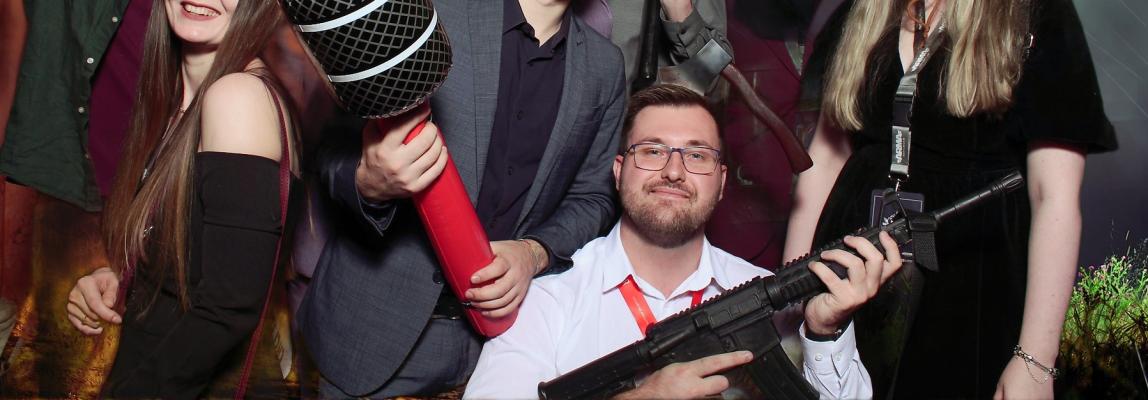
From student to producer: a chat with games alumnus Martin Bazlekov
07/13/2026 - 08:56

- Stories
What made you choose Breda University of Applied Sciences for your studies?
Martin: 'After finishing high school in Slovakia, I knew I wanted to study abroad. The Netherlands became the obvious choice once Brexit ruled out the UK, and it turned out to be one of the best decisions I have made. I actually started with Computer Science at Delft University of Technology, but I never stopped thinking about games. I had been playing them since I was five years old and had even attended summer camps where we made our own games as children. After my first year at Delft, I found the CMGT programme at BUas, applied, and the rest followed from there.'
You started out on the programming track. What made you move into production?
Martin: 'It happened quite naturally, during our first year group project, where we worked together with design, production and visual arts students for the very first time. There was no dedicated producer on the team, and things quickly turned chaotic. I was the one who got most frustrated by everyone moving in different directions, so I stepped in to help coordinate and set goals. That was the moment I realised production might suit me even better than programming.'
How did you develop your production skills while studying at BUas?
Martin: 'A fellow student called Nicole was giving lectures on production, and I started attending alongside producers from other years. It gave me proper grounding in the theory and best practice behind the role, and I picked up a lot just from hearing everyone share their struggles. I still have a notebook from that time, my own production bible if you like, and I still refer back to it today.'
What was the biggest challenge you faced during your studies?
Martin: 'Definitely our year three project, where I ended up as the sole producer for a team that grew to around forty people. Until then I had mostly worked in design and programming, so I suddenly realised how little I actually knew about disciplines like visual arts. I had to sit with every department, ask endless questions, and build a proper dependency roadmap so we all understood what needed to happen before what. There were also difficult calls to make along the way, including cutting a feature that one team member had put a lot of heart into. It was the hardest thing I did at BUas, but also where I learned the most.'
Was there a moment during that project that stands out for you?
Martin: 'Seeing our game at the Indigo showcase was one of my best memories. It was the first time I genuinely felt part of the games industry, standing alongside other studios and realising our work held up well by comparison. That gave me real confidence that everyone on our team was ready to be hired.'
How did you end up at Bohemia Interactive?
Martin: 'It is a bit of a story. I attended several portfolio reviews, hoping one of them would lead to an internship. One review with an executive producer from Bohemia Interactive was brutally honest and completely took my portfolio apart, in the best possible way. Later that same evening we all went out for drinks, and she got to see how I actually worked with people rather than just what was on paper. Months afterwards I found out that was the moment she decided she wanted me on the team.'
What does your role as Producer look like now?
Martin: 'I currently produce two teams of around ten to twelve people each, one working on the sandbox side of Arma 4 and the other on playable content. My days involve running sprint plannings, checking in with everyone, and setting goals with the team leads, alongside quarterly planning for the bigger picture. Compared to my time at BUas, my role has moved from being closely involved in the work itself towards a more supportive, coordinating position. Arma is such a complex game, built around letting players do almost anything, that the dependency mapping I first practised during my studies has become even more important here.'
Do you ever miss the more practical side of programming?
Martin: 'Sometimes, yes. There are moments when I miss having one clear specialism and not having to have difficult conversations with people across every discipline. But that is part of the job, and it is a job I chose. I have gained a lot of confidence in production since joining Bohemia Interactive, and I know now that this is the path I want to keep building on.'
What advice would you give to students who are still deciding on their path?
Martin: 'Just roll with it and see what happens. I switched tracks quite late and had no idea how things would turn out, but it worked out well in the end. Whatever direction feels right at the time, go with it and try not to look back.'
Follow Martin's journey and connect with him on LinkedIn. He also has a portfolio site, though he is the first to admit it is a little out of date these days.